



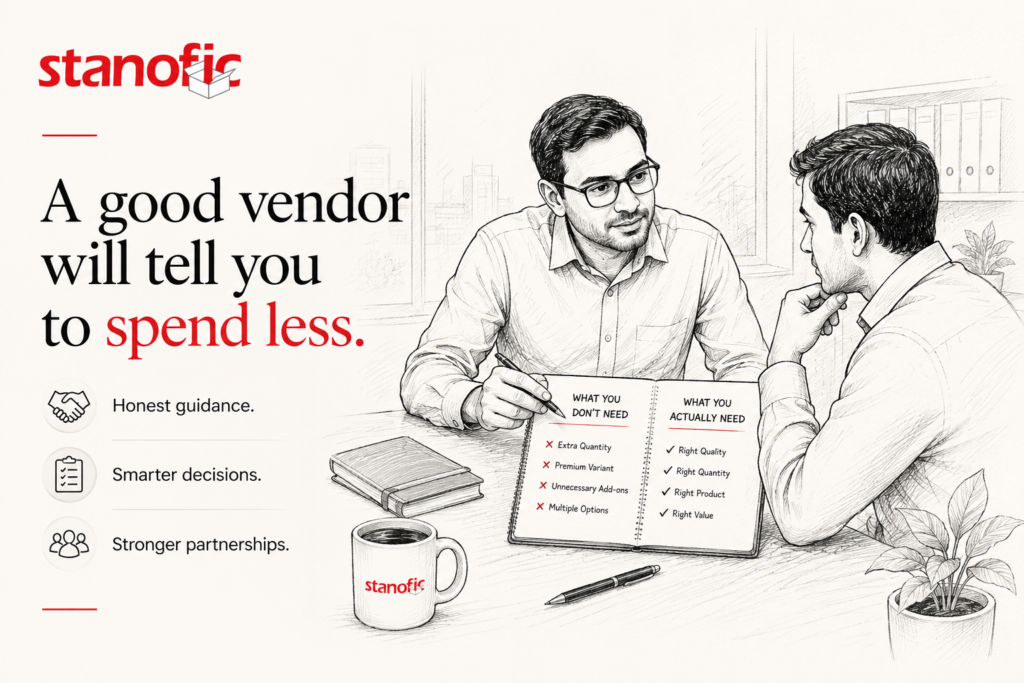
A client walks in with a budget of ₹1,000. They have a rough idea of what they need — maybe some stationery for a small event, a few branded items, some desk accessories. They list out products almost at random because they are not sure what exactly fits their requirement. Most vendors will take that list, bill close to the budget, and move on. A different kind of vendor will pause, ask a few questions, and sometimes say: “You do not need to spend that much.”
The temptation to fill the budget
When a client gives you a budget and a vague brief, the easiest thing to do is fill the order up to that number. Add a few extra items. Suggest a premium variant where a standard one would do. Round up the quantities. The client gets a packed delivery, the invoice matches the budget, and everybody moves on.
On the surface, nothing looks wrong. The client asked for products worth ₹1,000 and received products worth ₹1,000. But the question a good vendor asks is different: did the client actually need ₹1,000 worth of products to achieve what they wanted?
Often, the answer is no.
What a customer-conscious vendor does differently?
They diagnose before they prescribe. Instead of jumping straight to product suggestions, they ask what the requirement is for. Is it a client meeting? An employee onboarding kit? A desk refresh? The answer changes everything — the quantity, the quality tier, and often the product category itself.
They right-size the order. If 15 notebooks will do the job, they do not suggest 25. If a standard variant meets the brief, they do not push the premium. If the requirement can be met for ₹600, they say so — even though the client was willing to spend ₹1,000.
They protect the client from waste. A client who does not know exactly what they need is vulnerable to over-ordering. Excess stock sits in a cabinet, expires, gets forgotten, or gets used for the wrong purpose. A good vendor prevents that by matching the order to the actual need, not the stated budget.
Why this is a better business strategy than it looks?
On the face of it, a vendor who tells clients to spend less is leaving money on the table. One invoice, one transaction, one opportunity to maximise billing — gone.
But here is what actually happens.
The client notices. Maybe not immediately, but over two or three orders, they realise this vendor is not trying to maximise every bill. They start trusting the recommendations. They stop second-guessing the quotes. They stop shopping around for every small order because they know this vendor is looking out for their interest.
That trust compounds. The client who was going to give you a ₹1,000 order now gives you all their procurement — stationery, pantry, housekeeping, gifting, everything. Not because you were the cheapest, but because you were the most honest. The vendor who saved a client ₹400 on one order earns ₹40,000 a month in consolidated business.
Short-term restraint builds long-term relationships. Long-term relationships build long-term revenue.
How to spot a vendor who is actually on your side?
They ask questions before they quote. They suggest alternatives, not just additions. They occasionally tell you what you do not need. They track your past orders and flag when you are over-ordering or duplicating something already in stock. They treat your budget like it is their own.
These are not signs of a vendor who is bad at selling. These are signs of a vendor who has decided they would rather keep you as a client for five years than extract maximum value from you this quarter.
In a market full of suppliers competing on price, the ones worth partnering with are competing on something harder to copy: genuine concern for whether your money was well spent.
Stanofic works with businesses across Bangalore not just to supply products, but to make sure every rupee in your procurement budget is working toward something you actually need. Sometimes, the best recommendation is a smaller order.
